View from the Top banner

As we come to the end of 2025, it’s worth taking a look at where the NZ screen sector stands.

Global market pressures have been buffeting the New Zealand screen sector for years, and our hair is a little more than tussled.

Our industry has been in reactive mode for at least the last 10 years, at times trying but always failing to play catch-up as the constant winds of change sweep through the international film and TV business. This, of course, has been exacerbated by the damage wrought by Facebook (now Meta), Amazon, Apple, Netflix and Google (now Alphabet) [FAANG], the digital platforms hoovering up all the advertising dollars, the streamers, and the change in viewer habits.

The latest attempt to address the imbalance has been the changes to the international rebate that will take effect on 1 January 2026:

  • A lowering of the minimum qualifying spend for feature films from $15 million to $4 million
  • The reduction of the threshold for the 5% “uplift” from $30 million to $20 million
  • Allowing the 5% uplift to become available for Post-Production, Digital, and Visual Effects (PDV)-only projects and removing of the cap on “above-the-line” costs.

It wasn’t until the NZ line producers, studios, and other service providers started screaming that their side of the industry was falling off a cliff that the government did something about it—attracting offshore money is something our economic growth-focused government can understand.

Of course, these are welcome changes for crew, post outfits, and international productions looking for incentives for their next projects. Our service industry gets to survive a little longer.

But where, frankly, is the additional funding that’s going to support our domestic production sector?

There’s always going to be some form of limited funding available to make films and programmes with. However, it just won’t be enough for anything more than the cottage industry we seem to be rapidly becoming.

Over in Australia, they have at least made an effort to do something about it.

The Albanese Government has pushed through the Communications Legislation Amendment (Australian Content Requirement for Subscription Video On Demand (Streaming) Services) Bill.

The new laws, coming into effect on 1 January 2026, require streaming services with more than one million Australian subscribers to need to invest at least 10% of their total programme expenditure for Australia, or 7.5% their revenue, in new local drama, children’s, documentary, arts and educational programs.

While not the panacea everybody over there was hoping for, it’s generally perceived as a positive start.

Additionally, their government has added AUS$50 million over three years to the ABC funding pot to support the production of new Australian children’s and drama content.

Here, we have talked about the streamer levy for some time now. When the Ministry of Arts, Culture and Heritage released the Media Reform Discussion Document for feedback in February this year, proposals included that local and global streaming platforms would have local content investment “obligations”. At the time, MCH Minister Paul Goldsmith was reported as saying that the options would be looked at.

Coming off the Media Reform document and feedback, the launch in August this year of Amplify, the government’s five-year strategy for the creative and culture sector, is full of words and short of dollars. Here’s what it has to say about increased funding:

Action 1.2 – Leverage alternative funding sources for the sector to support sector sustainability and provide more jobs and opportunities for creative practitioners
Supporting activities
Increase philanthropic and wider private investment in the creative and cultural sectors using lessons learned from previous initiatives.

    • Timeframe: 2025–28

Action 3.6 – Explore initiatives to support increased investment in and access to local screen content; to grow the contribution of the screen industry to New Zealand’s economy and ensure it reflects and develops our cultural identity
Supporting activities

Increase reporting on the sector’s current involvement in local content to encourage further investment.

    • Timeframe: 2025–2030

While there are many wonderful, soft and fuzzy objectives in Amplify, a number of which, if achieved, could help the overall creative sector, there’s nada in it about direct, increased production funding for screen.

Meanwhile, the Fair Digital News Bargaining Bill and the merger of NZ On Air and NZFC have been put on hold. And it’s looking very much like the local content investment “obligations” have been put on hold, too.

In a recent chat with Minister Goldsmith, he told me that the government is looking at tweaking the domestic NZ Screen Production Rebate to make it work better for the local sector. But as I have also said to him repeatedly, we need more funding to make TV and film for the now highly international and competitive market we are in. His reply to date has always been that there won’t be additional funding coming any time soon out of government coffers.

So, how’s 2026 looking for us? Well, not all bad despite what I’ve written so far.

The recent Round Rua funding announcements from NZ On Air have given some production companies Xmas presents and a lifeline into 2026.

The changes in approach and personnel at NZFC are still being welcomed by the industry.

Some international productions shooting in New Zealand are confirmed, and there are possibly more headed our way next year, thanks in great part it would seem to the changes made to international incentives.

Taika, Cliff and Jason (Momoa) have reportedly bought Auckland Film Studios, so there’ll likely be some help there.

But there is still so much more that needs to be done to get us out of the “red” and into the “black”.

It’s worthwhile having a listen to producer Matthew Metcalfe’s interview on RNZ from the weekend for an additional perspective.

In the meantime, summer is officially here, there has been some good weather, and hopefully more to come.


Tui Ruwhiu
Executive Director

As a follow-up to this year’s Animation Matchmaking series, DEGANZ’s Izzi Hoskyn sat down with Ryan Cooper and Alex Leighton, two-thirds of the team leading Mukpuddy Ltd.

Mukpuddy originated from humble beginnings in 2002, starting in a basement before evolving into Aotearoa’s leading 2D animation studio. The team has created original shows, such as The Barefoot Bandits, Jandal Burn, and Night Eyes, as well as adapted Spike Milligan’s iconic Badjelly the Witch to the screen. Mukpuddy has solidified itself as a cornerstone of local animation, crafting worlds with a distinct style and humour appealing to audiences both locally and internationally.

In this kōrero, Ryan and Alex discuss the animation process, the secret actor living inside every animator, and some tips for local creatives to step into the world of animation themselves.


Izzi: So the first question is a biggie, but in fairly simple terms, what does the animation workflow look like?

Ryan: It all starts with us coming up with an idea we want to make. From the script, it goes into a combination of the voice recordings and storyboarding. Our storyboarders will jump into dissecting the script and start asking us for direction on how we see things. Then, background artists can start to get a sense of what environments we’ll need. The riggers can also start seeing what characters we need to begin building.

Alex: Character design also usually starts around the brainstorming and writing stage, depending on the project.

Ryan: And that’s quite nice for writing because you can picture the character in your head. Sometimes, we also know the voice actor you want, so you can write the character based on that as well.

Once we have the storyboards and the voices recorded, they are then sent to an animatic editor. They’ll compile all the storyboards and voices into a rough assembly so that we can see whether the episode is working before we begin animating. That’s where we’ll sometimes throw in temporary music, sound effects, and play with the vocal performances.

That’s the upside to animation: we can see whether the finished thing is going to be successful from early on.

Alex: Animation is very heavily loaded at the front end of production before animators even touch anything, especially if you’re building a new concept from scratch.

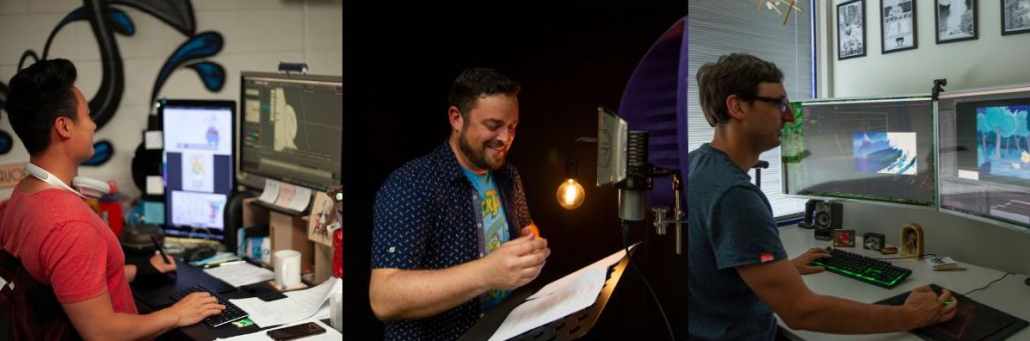
Stages of the animation workflow from character rigging, to voice recording, to compositing / Photos provided

Ryan: From there, it’s basically divvied out. An episode gets chopped up into its scenes and handed out to the animators. An animator can animate anywhere between 5 to 15 seconds a day, depending on the complexity of a shot.

Once the animation’s done, it goes to compositing. Compositors take the backgrounds, character animation, and any effects animation and put them all together to make it look extra pretty. You can add far more cinematic depth to something with techniques like focus pulls, lighting, or particle effects, which make it stand out from the average animated cartoon.

At that stage, we start looking at the final music, whether it’s production library music or a custom score. Then it’s all mixed, and that’s it.

Izzi: It’s interesting that you’re basically doing the edit before the project is even made.

Alex: That’s so important because then you’re not wasting an animator’s time and energy on something that might end up getting cut. We’ve probably cut one or two scenes from any of our projects after it’s been animated, but the hope is to avoid that.

Because our entire career hinges on storyboarding and animatics, it’s wild to think that live action doesn’t always do that. It’s a crucial part of the process for us.

Izzi: It’s a very different medium, and I think it’s reflective of the pace at which live action can be made versus animation.

Alex: Exactly, a film shoot can be six weeks, but Badjelly was over 70 weeks of work in total. Different departments were on for various lengths, but it’s a long production. That’s why we advocate for support in the animation sector because it creates jobs for longer.

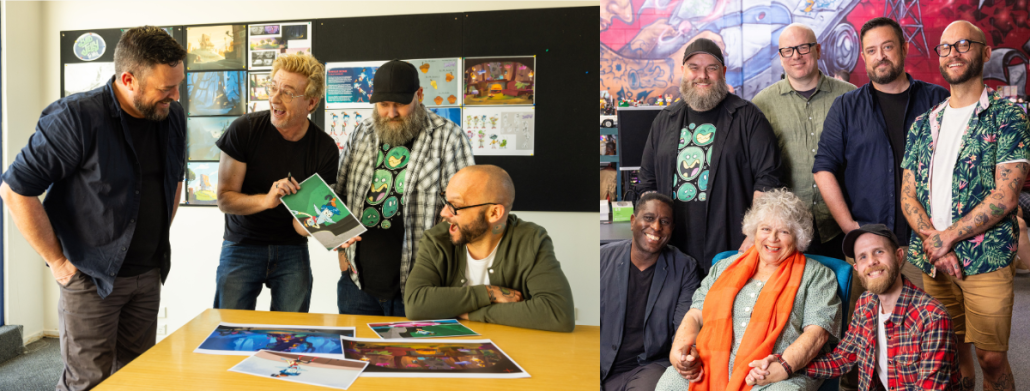
From the making of ‘Badjelly’ / Photos provided

Izzi: Could you also talk a bit more about how an individual animator will step into the process?

Ryan: We’re really big on animators bringing a piece of themselves to their scenes and taking creative liberties. Sometimes, we get a different vocal performance than we expected, so the storyboards don’t quite match. For instance, if we have a comedian in and they’re ad-libbing, we want the animators to match that.

Animators are actors in a way. They have to know how a person is going to react, how they look with certain emotions, comedic timing, and all that. It’s always exciting to see what can come out of a really talented animator who has a secret actor living inside them.

Alex: For Badjelly, we suggested that the animators film themselves acting out scenes. It gives them the chance to embody the character. That’s the moment the show comes to life in a lot of ways. You know, the characters are moving, blinking, and talking. We have a big emphasis on acting and reminding people that you don’t just act with your whole body. Sometimes it’s a subtle eye dart or a little hand gesture.

We also keep an open-door policy if animators want to come and talk to us as the directors. They have their team leaders whom they report to on a day-to-day basis, but if they want to speak to us as directors, we’re always open to a chat because we love getting into the nitty-gritty of it. Often, animators will come to us and ask, “What’s the emotion?”

Ryan: Or “What do you think the character is really meaning when they’re saying this?” It’s fun to talk about, you know, it’s a silly cartoon, but there’s real depth there.

Izzi: I was going to ask about where creativity comes into the technical aspects of animation, but it sounds like it’s just acting through drawing?

Alex: It is very technical, but the performance art of it all is what so many animators love about it.

Izzi: How do you maintain consistency in a character’s ‘performance’ if you have multiple animators working on them across various scenes or episodes?

Ryan: As the directors, we’ll try to set those boundaries up front. We might say, “This is a cartoon, but the physics are real.”

For a show like The Barefoot Bandits, the idea was that fantastical things are happening in this world, but the three main kids are grounded in reality. They can’t stretch and do things that SpongeBob could do, or magically pull things from behind their back. It’s quite fun when you set those rules because the boundaries can make for really interesting animation choices.

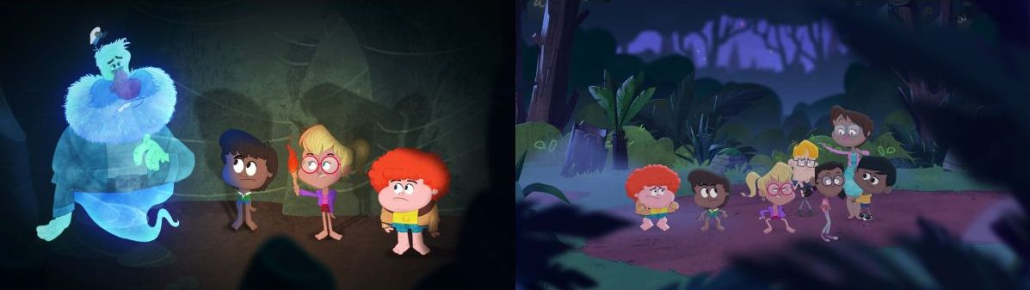
The Barefoot Bandits / Stills provided

But it’s also just a matter of all the animators being able to see what the others are doing. Sometimes one person sets the tone, and everyone agrees that’s what it should be. It may require a bit of looking back and forth, but people often check to see who has tackled a character first. It happens naturally, and vocal performance also helps.

Alex: If an actor’s performance is very low-key, then there’s no need to go big with their animation.

Izzi: Who else in the production does an animator work closely with?

Ryan: They often work closely with background designers because if a character is interacting with the background, the animator will need to have the final version of it before animating the actions. They also work closely with compositors. They may have a set of expectations of what needs to be delivered, whether it’s just a technical file or if they have some other ideas of what could make it look extra good in the final product. And riggers, who make the characters. They can get feedback from the animators, asking for tweaks to the way a character is built.

Izzi: Mukpuddy is both creating your own IP and working with other studios or companies. Is there something that you wish collaborators knew before approaching you for a project?

Alex: If it’s a service gig where someone comes to us with an idea and we animate it, it’s important to know what your budget is, be honest about it, and have some kind of knowledge of what we do and what our studio makes. Also, having an understanding of how a budget dictates the scope of an animated project. We don’t just point and shoot a camera. Everything on screen is designed, drawn, rigged, and then integrated into the animation pipeline. It’s time-consuming and a tricky medium to come into naively.

Also, having as many reference materials and resources as possible is really helpful, so we’re not taking a stab in the dark when we come on board.

Ryan: I think a good thing for people to know before they get into this stuff is to put ego aside. The thing you’re making is important, but it’s always nice to take the path of least resistance. Obviously, you want to stand your ground on things you believe in, but it’s good to check whether that’s just pride getting in the way.

Alex: It’s a collaboration all the way through. Which is true for the entire screen industry, but in animation, it just feels like there’s an extra layer. Everybody needs to communicate in a healthy way to get the job done.

Ryan: Consideration for people next in line is a big one. So, when I’m writing, I ask myself, “Do I need to include this prop in this scene? Is this important?” And if the answer is no, I just get rid of it straight away because someone will be spending a lot of time on that one prop.

Alex: Or you’ll ask, “Have we seen this prop in a previous series? Was there a mug or a cup, or a pen?” I’ll check, and if yes, then sweet, we can reuse it.

Ryan: Or if not, is there something else I could use for this gag that would have the same impact? Knowing that someone is next in line to do their part of the job and trying to hand it off as kindly as possible is great.

Character and Location Concept Designs for ‘Night Eyes’ / Photos provided

Izzi: What would you recommend to people who want to get into animation in Aotearoa, whether they are animators or those who want to write or direct for animation?

Ryan: Keep absorbing what’s out there. Have your finger on the pulse because inspiration can come from anywhere. The people who do best are those who know what’s happening in the industry. They know what cartoons kids are watching these days, who’s making those shows, who’s directing them, and who’s designing the characters.

Alex: The people who have longevity in the industry are the people with the ambition and the love of it. You know, meet with your peers and make a little animation gang to create stuff together.

Also, upskill where you can. If you know how to animate in Flash, maybe you can get some work animating in Toon Boom. So learn a few different softwares.

Ryan: As Ross Geller famously said: pivot. The road can get a little bit windy, but as long as you’re related to the thing you want to do, I think that’s pretty good.

We’ve had crew members who have jumped from animation to rigging and from storyboarding to background art and vice versa. Being a jack of all trades is useful. At the very least, having an understanding of who the other roles are in the industry is great because you might find yourself being in one of those roles from time to time.

And the last thing is just talk to the studios that are out there. The more you pick the brains of the people who’ve been in it for a long time, the more skills you’re going to pick up. So here in New Zealand, talk to us, Flux, Yuk Fu, speak to any of these people.


This interview has been edited for brevity and clarity.


View from the Top banner

The Directors and Editors Guild of Aotearoa New Zealand is both a guild and a union. We’ve been a union since 2019. The NZ Writers Guild started out as a union in 1976 and Equity New Zealand came into existence as a union in 1944. We three are the unions in New Zealand’s screen sector, and are affiliated to the New Zealand Council of Trade Unions (NZCTU).

I attended my first NZCTU biennial conference last week. One of the biggest impressions left on me from the conference is that unions are bastions of democracy. We are large and small, democratic, membership-based organisations that foster active participation. We give workers a collective voice in public policy discussions, strengthening democracy at both the workplace and societal levels while striving for workers’ rights.

So much of my work at the guild, and my colleagues at the other guilds and associations, is taken up representing you to funding bodies, government ministers and ministries, other organisations, companies and individuals. We work to make your working world better.

Another lasting impression from the conference was the unity that all unions have in pursuing the best for their members, many of whom are in a less fortunate space than those of us in screen.

DEGANZ, NZWG and Equity NZ, joined by SIGANZ and SMSG, are united in their efforts to get collective bargaining underway under the Screen Industry Workers Act.

At our Collective Power Workshop last weekend, explaining what the Screen Industry Workers Act is all about, it was encouraging to see screen workers from a variety of disciplines in attendance. They were actively engaged in learning what SIWA can do for them and how it can help to bring our industry onto a truly professional footing, on par with developed nations elsewhere. Which is why it is so disappointing that we have disunity in our sector over SIWA. All at a time when so many voices are calling for us to be united to confront the challenges facing us in screen.

I encourage all of you to watch the Choir! Choir! Choir! rendition with Patti Smith of her song ‘People Have The Power’ on YouTube. These lyrics particularly resonate:

that the people have the power
to redeem the work of fools
upon the meek the graces shower
it’s decreed the people rule

For all of you who seek a more professional New Zealand screen industry that truly embraces collaboration, wellbeing and equity, it’s time, as Patti Smith so eloquently says at the end of the performance, to…

Use your voice!


Tui Ruwhiu
Executive Director

View from the Top banner

Today, Thursday 22 October, it’s expected that more than up to 100,000 doctors, nurses, allied health workers, and primary and secondary school teachers will go out on strike. They are seeking better pay and working conditions, and better environments in their work places for every New Zealander. All at a time when many people, including many of those going on strike, are doing it tough.

Screen industry workers under the Screen Industry Workers Act, however, are prevented from striking. It’s one of the concessions that was made to help ensure collective bargaining for screen workers would become a reality when the legislation passed.

Well, the legislation passed. But what hasn’t happened is the collective bargaining.

SPADA, the representative body for screen producers in New Zealand, has not registered since the Act came into force in December 2022, even though they said they would.

That is more than two and a half years of ducking and diving from them while we, Equity NZ (actors), NZWG (writers), and more recently SIGANZ (techos) and SMSG (composers/audio)—all registered parties for collective bargaining—have been meeting with SPADA and amongst ourselves, to make it as easy as possible for them to fulfil on their promise. We haven’t been sitting on our hands. We just haven’t been public about it until the first quarter of this year.

Recently in industry news, SPADA’s recalcitrance has received the spotlight. An increase in cost for production due to increased pay rates has been highlighted as potentially a key reason why SPADA doesn’t want to engage. This is the scare.

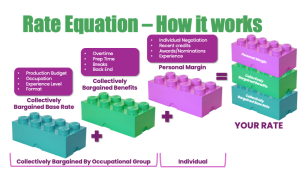
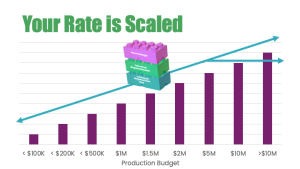
The reality: Collective bargaining will set the base rates of pay—the rates below which nobody can be paid. This does not mean high rates of pay across the board. At our Creative Power workshops, this is how we propose pay rates be established:


What you should deduce from this is that base rates of pay will differ depending on the size of the budget (budget ranges also to be negotiated). This will allow lower budget TV productions and low budget films to still be produced—a high percentage of NZ TV production is lower budget. What does low or lower budget mean? That’s to be negotiated in collective bargaining as well. Allowances would likely be made to accommodate short films and ‘amateur’ productions, i.e., no or micro-budget productions and small-budget, self-funded productions.

All of the guilds realise that there is a limited amount of production funding available. And we all want to ensure a healthy and vibrant screen production sector making New Zealand content, and servicing international production. So, we will be pragmatic in approaching collective bargaining.

SPADA: there’s nothing to be scared of. Clarity is a win for everyone.


Tui Ruwhiu
Executive Director

For this iteration of DEGANZ’s new blog series, A Kōrero With…, Izzi Hoskyn spoke with Director of Photography Simon Raby NZCS.

Simon is a freelance Director/Cinematographer with 45 years of industry experience. He works largely in feature films, both local and international, with credits such as The Lord of the Rings, District 9, Elysium, Deathgasm, No Exit and The Heart Dances. His latest project is as Cinematographer on Rebecca Tansley’s feature opera documentary Tenor. In 2018, he was awarded official accreditation from the New Zealand Cinematographers Society (NZCS).

In this kōrero, Simon shares his technical and creative processes, shedding light on the unique skills that a DOP brings to a project to interpret the director’s vision and help serve the story.


Izzi: What does a Director of Photography do?

Simon: At its most basic level, a DOP is responsible for how the images look on screen. My job when working with the director is as an interpreter. I’m interpreting the script, the director’s vision, and the film’s emotions and themes. For example, we may have decided to incorporate a colour theme that appears at specific points in a film to remind the audience of something or to make them feel a certain way. So, it’s not spoken, and it’s not necessarily part of the script, but you might find ways of associating certain things with a subconscious subtext, if you like. It’s all to help the narrative. I’m a storyteller, just like the director, and I have tools in my skill set that help me tell the story.

That’s why I’m called a director, because I will direct the photography in a way that interprets the director’s vision.

I’m also a translator. Once the director and I have a clear vision of what we want to do, I then translate that into technical instructions for the crew.

Izzi: I like how you described it as being a translator where you’re essentially translating the director’s vision into tech speak.

Simon: It depends on the director because every director has different strengths. Someone like Nikki Caro, who is an incredibly strong actor’s director, can very succinctly convey what she’s trying to do, but won’t necessarily say, ‘Throw on a 40 mil or throw an 85 for this.’ It’s up to me to interpret the director’s vision and go, ‘This is going to be the right lens for this kind of field of view and how much we want the background to be in or out of focus.’ But some directors, like James Cameron, will say, ‘I want a 135 on that camera,’ and he’ll know all the depth of the fields. In that instance, as a DOP, you are more in charge of making sure it all happens.

So, it really depends on what the director wants and how much they’re looking for. Most DOPs are more than happy to support the director in any way that works for that particular dynamic.

Simon working with director Rob Sarkies / Images: Provided

Izzi: The relationship between the DOP and the director is at the core of your job, but who else in the production do you work with?

Simon: The departments that the DOP is directly responsible for are the camera, lighting, and grip departments. That’s the sphere of influence that I have in terms of who I’m directing as the Director of Photography. Outside of those three teams, I also liaise with the Art, Makeup and Costume, Locations, SFX, and VFX Departments over a multitude of onscreen details.

Izzi: What does your workflow look like?

Simon: The first thing I do is read the script, and I’ll usually read it with just the story in mind at first. I’ll make notes at the end about my thoughts, how it might feel, and what sort of things came to mind as I read. Then I’ll reread it and start thinking about potential technical things.

Then I’ll usually have a series of meetings with the director, where we’ll review the director’s resources, like the mood board, and discuss them at length. From that, I will gain a clear understanding of some of the technical challenges. It’ll help me start to break down the sorts of equipment I’ll be asking for because all this is tied to budget.

Then there are a series of pre-production meetings with all the department heads, where you’ll do script breakdowns and discuss how we’ll approach certain things. Then, you’re off to do technical recess and tests. You might be doing tests with visual effects as well. You’re working with all these different departments because you’re all interested in what ends up in the frame.

After that prep process, you go into shooting and watching daily rushes with the director.

At the end of the shoot, it’s all kind of over for the DOP until the edit’s done, unless there are pick-ups. You don’t come back until the colour grade when you’re in a suite making the colours and the contrast and the look of the film as sweet as you can, often with the director.

Simon on set / Image: Provided

Izzi: The last blog we did was with Damian McDonnell, who discussed how his job as a colourist involves working closely with the director and DOP to bring their images to life. Do you have any insights on the DOP-Colourist dynamic?

Simon: Those relationships are quite personal. A colourist is both highly skilled and has strong creative ideas about how the film should look.

I’ve worked with Damien before; we did Mortal Engines together. He was the on-set colourist, and it was great because we got to set up a look on the shoot day, and then eight or nine months later, we got together again to finalise it all. So we got to know each other reasonably well. He’s such a skilled colourist and has strong ideas about how things could look, so sometimes we had to consider who had the better idea for how something should look in the grade. But it’s always about what’s best for the film and the story.

Izzi: So, we’ve discussed the technical workflow. What’s your creative process?

Simon: Personally, I rely quite a lot on instinct. I have instinctual feelings about the way I’d like to cover things. But if I had to really break it down, I know that maybe some of that is habit and some of it is cultural influences. There’s no right or wrong way, but there are more effective ways than others at telling a story. For instance, when I break down a script, I always look for important beats.

Where you put the camera is vital because it tells the viewer where they are in the room. Being in someone’s face on a wide lens is much more intimidating than watching the person from the back of the room on an 85mm. Their face is the same size in the frame, but you know you’re closer or further away because you can feel it through the lens choice.

Izzi: What sort of conversations do you have with the director around finding the beats in the scene?

Simon: That’s again a really personal thing, depending on the director. I have to feel out the director when I first meet them.

But I think it’s important to be aware that the director is responsible for how that film turns out. You’re job isn’t to say, ‘Well, my idea is better.’ Your job is to help the director make the film great. And if the director hasn’t got a vision, then often the DOP will step in and fill the vacuum, because someone will need to. So it’s really good when a director can make those calls.

Izzi: Is that something you wish collaborators, specifically directors, knew when working with you as a DOP?

Simon: Yeah, I like it when the director has a clear decision-making process, and they know what they want to do. That’s not to say that I want them to be closed to ideas, because on a good shoot, everyone is giving good ideas.

The other thing I would like to say to collaborators is that the sooner you can address something in pre-production, the smoother shooting will go. If a director suddenly says 30 minutes before shooting that they want a shot to start from above the roofline, come down the chimney, go down the pipeline, then finish on the grass, I may not have the equipment I need to make that happen. So if the director has a clear idea of the sort of shots they want to get before the shoot, it helps both the DOP and First AD.

Izzi: Do you have any thoughts on the DOP-First AD-Director dynamic?

Simon: There’s a huge amount of work that a DOP does with the First AD prior to the shoot starting. It’s an essential communication process because the First AD is working directly with the director, and they’re in the middle of the director’s quest for creative brilliance, and the production’s need to finish things on time.

Inexperienced directors will often be steered quite heavily by both the First AD and the DOP, who are working together to make sure that the schedule is honoured alongside the creative vision of the director. There’s a three-way responsibility there.

Photos from across Simon’s Career / Images: Provided

Izzi: My last question is more specifically focused on your career. What has been a career high for you?

Simon: District 9 was really great because I was directing and shooting the second unit. I would go to Neil, who was the Director, and ask what he was looking for in a scene, and he would look at me and say, ‘Just make it cool.’ 

And I didn’t have to spend a lot of time discussing or debating with my DOP because I was the DOP, so I could just get on with it. It was very freeing from my point of view. There were big days, but the crew was really accommodating. I had fun on that show.

Izzi: It’s interesting that you’re able to cross between being a director and DOP, or even hold them at the same time.

Simon: It depends on the intensity of the project, really. District 9 was moderately easy for me because it was mostly on-the-shoulder handheld. It was all rough and mockumentary style.

Directing and DPing use different parts of your brain as well. I like directing because I enjoy working with actors. It’s the same when operating the camera, which I love to do. I much prefer being in front of the actors with the camera than in a tent far away. It’s that closeness to what it’s all about, which is the story and the performance.

Izzi: That seems to be the common theme from these kōrero. It always boils down to the importance of the story.

Simon: Absolutely!


This interview has been edited for brevity and clarity.