The Copyright Act Review is back on, with a proposed Stage 1 set of proposals being finessed for feedback.
Although we lobbied long and hard on behalf of directors in the previous review started in 2017, the whole review was ultimately put in the too hard basket in 2020 by the government. COVID didn’t help.
DEGANZ has been seeking shared copyright for directors with producers since 2005.
The NZ Copyright Act says that the author and therefore the copyright holder is “in the case of a sound recording or film, the person by whom the arrangements necessary for the making of the recording or film are undertaken.”
The default interpretation of this has long been that it is the producer who does this, therby making them the author, and thus the copyright holder.
Our position though is that the Director is the creative decision maker in a process of artistic collaboration who takes final responsibility for the aesthetic cohesion and artistic integrity of the work. One of the elements the Director uses to create the final work is the screenplay. The other underlying elements include the actors’ performances, cinematography, the production design, the wardrobe and makeup, the editing, the musical score, the sound design, etc. These are underlying works that contribute to the film through the talent of the Director.
Just as the writer is the “author” of the screenplay, and the composer is the “author” of the musical score, the Director is an “author” of the film or audiovisual work.
What has prompted the government to put the Copyright Act back on the table is the major transformation brought about by the digital age, and the scary beast that is AI. As well, it has obligations to address certain copyright requirements that were put in place with both the recent UK and EU Free Trade Ageements (FTAs).
As part of the representations we made on behalf of directors as the FTAs with Europe and the UK were being negotiated, we highlighted:
In the UK, their copyright act stipulates that the producer and the principal director are joint copyright shareholders of the film.
In the EU, an EU council directive requires all European member states to recognise the principal director of a film or audio-visual work as an author—and therefore first owner of copyright of that work.
In more than 37 other territories around the world, the director is the primary copyright holder in the work.
As directors are already recognised as authors with moral rights over their work under the NZ Copyright Act, you’d think it was a no brainer for government to accept that the economic rights conferred by copyright would go to directors, too. But no, that logic has proven one step too far for our beaurocrats and ministers to get their heads around since we started way back when.
We are back at it in this stage of the review, though. Even though it’s not on the government’s agenda at this point.
It’s a long hard row that we have to hoe until plain common sense sees through.
https://www.deganz.co.nz/wp-content/uploads/2022/12/View_from_the_top_new.png7361280Tui/wp-content/uploads/2021/10/DEGANZ_logo_home.pngTui2025-06-26 14:46:422025-06-26 14:55:12Round Two
The Cannes film festival is over for another year. And it’s another year where no New Zealand film got into Official Competition, Critics Week, Director’s Fortnight, or the short film competition.
The last NZ feature in Cannes was Cristine Jeff’s Rain 24 years ago, in 2001. Zia Mandviwalla’s Night Shift was the last short film in competition at Cannes in 2012.
Looking across the ditch to Australia, we can see that they have continuing success at Cannes with features. From 2001 – 2025 according to Screen Australia, the Aussies had 22 feature films at Cannes in either Official Competition, Critic’s Week or Director’s Fortnight. On the shorts side, they have been less successful with only 3 shorts chosen since 2012.
Of those 22 features according to IMDB Pro/Box Office Mojo numbers, it seems that for Australian theatrical:
6 did not get a release
3 earned less than NZ$500k
2 earned less than NZ$1 mil.
2 earned between NZ$1 – 2 mil.
1 earned $2 – 3 mil.
2 earned $3 – 4 mil.
3 earned between NZ$4 – 5 mil.
2 earned $6 – 8 mil.
1 film releasing in June 2025 has no B.O. yet
It’s safe to say that those that did not get a release were strong arthouse films, while a good number of those with high box office returns were horror/thriller, with the others of various genres from drama to indigenous. So a pretty wide spread of films that achieved from no Australian box office success to great results.
A quick scan of two other countries with similar populations to NZ—Denmark and Ireland—reveals that Denmark has had five features in competition at Cannes since 2001, while Ireland has had six.
If we look more closely at the NZ films that have been selected at Cannes we see:
1982 The Scarecrow, Sam Pillsbury, Directors’ Fortnight
1984 Vigil, Vincent Ward, Official Competition
1987 Ngāti, Barry Barclay, International Critics’ Week
1988 The Navigator: A Medieval Odyssey, Vincent Ward, Official Competition
1993 The Piano, Jane Campion, Official Competition
1998 Memory & Desire, Niki Caro, International Critics’ Week
2001 Rain, Christine Jeffs, Directors’ Fortnight
So why don’t NZ features get into Cannes anymore?
Do we lack the auteur directorial talent? Is NZFC too risk averse when it comes to script development? Does a market and cast-driven approach spoil our chances? Are we lacking in boldness and originality? Are our films not good enough on an international filmmaking level?
It would seem that it’s a combination of a number of these things, according to a couple of very experienced film industry practitioners whose opinions I value.
We certainly are very capable at climbing mountains in this country. It just seems that the cinematic peak of Cannes proves difficult to scale for NZ films except for the very few, now quite some time ago.
https://www.deganz.co.nz/wp-content/uploads/2022/12/View_from_the_top_new.png7361280Tui/wp-content/uploads/2021/10/DEGANZ_logo_home.pngTui2025-06-12 11:43:432025-06-18 19:53:53Cannes… One Mountain Too High
Donald Trump’s tariff threats on film is causing considerable angst globally and extreme nervousness in New Zealand, even though detail is still entirely lacking, apart from Jon Voight’s plan, which seems to have triggered Trump’s reaction.
In discussions with the Directors Guild of America two weeks ago, I was informed that production in the US was already down by around 40%. Estimates put the global decrease at 17 – 20%.
Anecdotally, we seem to have a reasonable level of international production here right now with at least two Evil Dead films, Gollum and Zelda. The forward slate from June is supposedly looking positive at this point, too. Of course, things could change dramatically in an instant, depending on which way the wind is blowing Trump’s ‘do’.
Even though NZ seems okay for now, there is concern regarding the uncompetitiveness of our international screen production rebate at 20% plus a possible 5% uplift. When they can get a guaranteed federal 30% plus state rebates that can add up to 10% or more in Australia, it’s not hard to see why US production continues to go there.
The US guilds are cautiously supporting the call for more production to stay in California and the US, even though there is a general acceptance that runaway productions are still a necessity for the system to function.
The NZ above-the-line guilds and associations who depend primarily on domestic production for our members to be gainfully employed are much more interested in the funding available for making local films and programmes.
Scripted is still the biggest employer of crew, while scripted and factual are good job sources for both directors and editors. The funding available from NZ On Air, the New Zealand Film Commission (NZFC) and Te Māngai Pāho (TMP) is therefore crucial for the creative, cultural and financial wellbeing of DEGANZ members.
For NZFC and NZ On Air, funding comes from Vote Arts and Culture and for TMP, Vote Māori Development. For many years, the funding was essentially at a default setting. But as we all know, NZFC funding was cut last Budget, although NZ On Air’s and TMP’s funding remained the same. With the Coalition still focused on cost cutting, how our funding bodies will fare come Budget time next week is on many people’s minds.
International production is the rich cousin when it comes to the New Zealand screen industry. But international and domestic are in a symbiotic survival relationship, even though those who work primarily in international sometimes forget that. Should international production drop off, we are going to need a greater increase in funding for domestic production than we already require to carry the load. Here’s hoping Minister Goldsmith has pointed this out to his cabinet colleagues in a convincing manner.
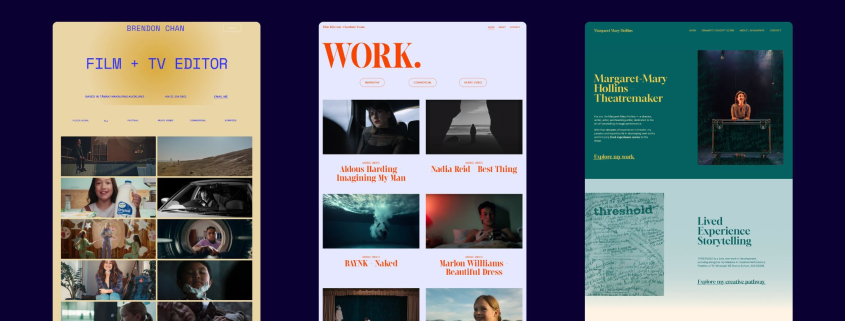
It can be useful for freelance filmmakers to have a professional online space for their work. DEGANZ’s Events and Membership Coordinator, Izzi Hoskyn, sat down with Tema Pua of Tempixel Design to chat about how having a website can help freelance filmmakers’ careers.
Tempixel Design is offering to make web design more accessible for DEGANZ members with exclusive discount codes. DEGANZ members can now get 20% off Tempixel’s website templates and 10% off the Superpixel design days.
For more information on how to access these discounts, log in to your DEGANZ account and navigate to the Member Discounts page.
Izzi: Thank you, Tema, for taking the time to chat with me today.
Tema: My pleasure.
Izzi: Can you tell our DEGANZ membership a bit about yourself and your web design business, Tempixel?
Tema: I run a small business called Tempixel Design. I’m a Squarespace web designer specifically for filmmakers, theatre artists and performers because I am also a filmmaker myself. I direct short films, I script supervise, and some of the members may recognise me as someone who used to work at DEGANZ for 6 years before I left to dedicate more time to film. I also ended up starting this business in that time.
Tema Pua and Tempixel Design logo / Photos supplied
Izzi: Nice. Why would a TV and film practitioner benefit from a website if they can promote themselves and their work on social media?
Tema: I think when we’re talking about film and TV, the industry has run for a long time—and still does—based on relationships, networking and the people you know. I think that’s a great but challenging part of our industry. But I do feel that the internet is so integral to our lives and that it’s becoming more and more important for filmmakers to have a website to promote themselves.
Having a website is a space where you can be in control of what narrative you’re putting out, that’s free from a big company’s social media brand. You’re not having to change what you do based on an algorithm or a platform deciding that they prefer a 4:5 aspect ratio, for example.
I also think ‘How often do we like to Google people?’ I was looking for a cinematographer for my short film last, last year, and I started with a long list of DPs that had been recommended to me, or ones that I had heard of through the grapevine. So what did I do? I started to go through that list one by one, Googling them.
And that’s where I think having a website to promote yourself is key to raising awareness amongst people who might want to hire you or work with you on a project, versus someone who just has an Instagram.
Izzi: Yeah, it acts more as a professional landing page for anyone who’s looking you up online.
Tema: Yeah, essentially, you can use your website to communicate your professional identity. And that can be very close to who you are in real life—hopefully! Because I’m hoping we’re all trying to be authentic. But it can also be different—to show like ‘This is me as a professional, and this is the kind of work that I do and how I approach my work professionally.’
Websites by Tempixel Design
Another big benefit of a website is that it can help you define what you do.A website can be quite useful for—particularly in New Zealand, where we often wear many hats—clearing up any confusion around what you do. Whether you want to promote all of your jobs or just your directing portfolio, for example.
I think it is important to remember that a website is essentially a marketing tool. It’s just a different marketing tool to social media. And if you’re going to have a website, it’s going to be more beneficial if you think of it as a way to help you market yourself. Rather than: ‘Okay, I just stick my work up there.’
Izzi: And hope for the best.
Tema: Which often tends to be the case in screen. But you never know, having a website could give you the edge over someone else to get a job.
Izzi:We’ve talked a lot about the pros of a website. But how easy is it to build your own?
Tema: Today, now more than ever, it’s very easy to build a website because we’ve got website platforms that are easy to use, created for non-designers. I’ve chosen to work in Squarespace because I think it’s really easy to use and the learning curve isn’t steep. It’s quite easy to equip my clients to be able to use it. And I think that can be very empowering, because you may not want to keep paying a web designer or developer to update your website whenever you want to make a change, which used to be the case.
I did want to mention, though, that while it’s easy for people who don’t work in web design to create their own website, it’s good to be aware of basic web design conventions. For example, creating a website that’s easy to use and navigate is important.
Izzi: What then are some tips and tricks for designing your own website?
Tema: One area where filmmakers can improve their websites is to include one or more photos of yourself on your website.
Remember that we are a relationship-based industry. So, personal connection is important. Allowing someone to see another human being’s face is a really quick way for our brains to be like, ‘Oh, okay, I could possibly connect with this person.’
I also think what’s really helpful is explicitly telling people what kinds of projects you’re interested in working on. Because it can already be a guessing game. When you haven’t met that person, it can be hard to know what they want to be working on just from images and videos from their portfolio.
Examples of non-faceless websites by Tempixel Design
Izzi: Shall we finish with how Tempixel Design can help DEGANZ members with starting their website journey?
Tema: If you’re building your own website, I write a blog where I share tutorials, tips and guides specifically around Squarespace for screen and theatre practitioners. So feel free to check that out.
I’ll be providing a discount for DEGANZ members on all of my website templates for Squarespace. A premium template can help you get a leg up if you’re not sure where to start or you don’t feel you have sufficient design skills.
Members can also get a special discount on my Superpixel design days if you would rather leave your website with an expert and have your to-do list done for you. And tasks can be anything that you just can’t fix yourself or don’t have the time for, or maybe you want to refresh your website.
Izzi: Amazing! Thanks again for your time, Tema.
This interview has been edited for brevity and clarity.
https://www.deganz.co.nz/wp-content/uploads/2025/04/Blog-Header.jpg7802060admin/wp-content/uploads/2021/10/DEGANZ_logo_home.pngadmin2025-05-01 17:05:112025-05-01 19:31:59How a Professional Website Can Help Your Film Career
We held a successful Screenlink event last night together with Advertising Producers Aotearoa. The topic was the nature of working across TV commercials, scripted and narrative features.
It was interesting to hear about the pathways from some of the people in the room on how they got into, are progressing, or got ahead in the screen industry.
A common theme from some was the low-budget scripted pathway through TikTok and web series. We’ve seen this with some of our members, writer and director Victoria Boult being the most recent example, with nOOb.
nOOb started out as a short, scripted TikTok series funded by TikTok and NZ On Air, and became a half-hour series now available on ThreeNow. The show has since been selected to appear at the Berlinale Series Market this year, and recently earned a spot at Canneseries 2025, where Victoria is heading off to shortly.
While just doing it is definitely a path that can work, either self-funded or with funding assistance, the guild worked on more formal pathways with other guilds and associations for new entrants to the working screen industry.
We spent two years engaging with the SkillsActive initiative, and then for two years with Toi Mai, the Workforce Development Council that included the screen sector, which replaced SkillsActive.
With the change of government at the last election, Te Pūkenga, the amalgamation of Institutes of Technology and Polytechnics (ITPs), and Toi Mai are disappearing. The disestablished Te Pūkenga will essentially go back to the old model of a network of Institutes of Technology and Polytechnics (ITPs). Meanwhile, the Workforce Development Councils (WDCs) will be taken over by Industry Skills Boards.
The work we and the other guilds and associations did across those four or so years, while not a complete waste of time, does frustratingly seem in large part to be in vain. To be totally honest, we are pretty much where we were five years ago when we started on this.
One of the issues that we constantly encountered was the round peg screen industry being forced into the square hole of the formalised vocation training sector. It was never a comfortable match no matter how much your tried to shave off the round peg to fit.
Educational theory has its place, as do the practical elements of production as practised at the various film and media schools. But they never really prepared the graduates properly for the requirements of the working screen industry—something we all really wanted to address. This was made difficult, however, by the nature of screen sector work itself, which can be intermittent, is rarely long in nature, and requires screen workers to move from one production company to another, making tracking and training difficult.
We haven’t given up though.
When the new entities are in place we will undoubtedly engage with them once more and try to find a way through. But we’d much rather just be given some of the money, which for the wider reform of vocational training has gone into the millions of dollars, and get on with it ourselves.
We know pathways are needed. And we know we can build them if we are given the resources to do the job. That’s undoubtedly too simple a solution for what is made out to be a complex problem, certainly for the screen sector.
In the meantime, we encourage you to just keep doing it as well. And networking to find your way in—a tried and true method that still works.