This DEGANZ Watch List features new factual series and the online release of the 2026 Day One Shorts, following their premiere at Show Me Shorts.

Season two of Licence to Drive, by DEGANZ member Robyn Paterson, arrives on 4 November. The series puts Kiwis with disabilities in the driver’s seat as they navigate the milestones, nerves and hijinks of learning to drive. Watch the trailer below for a first look at the new season.

Also new to the factual space is Te Ara Poutama, a web series directed by DEGANZ Vice President Rāhera Herewini-Mulligan. Edited by both Rāhera and her wife and fellow member, Janice Herewini-Mulligan, the series follows rising Māori talent in the music industry.

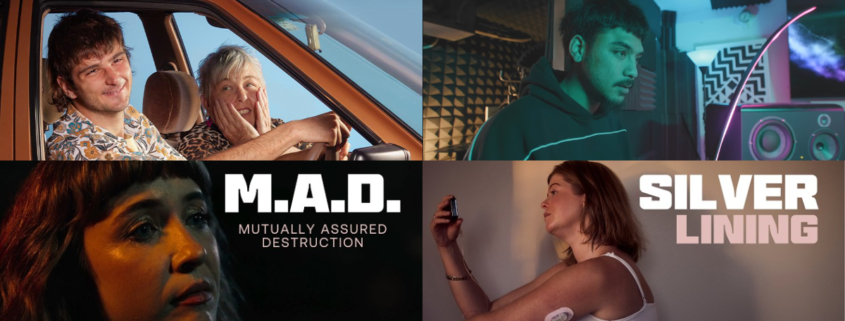
The 2026 Day One Shorts also spotlight emerging filmmakers, with both documentary and drama represented. In Silver Lining, Harriett Maire (DEGANZ) distils 25 years of living with a chronic illness into a 15-minute documentary, edited by fellow member Josh Yong. Meanwhile, DEGANZ member Connor Amor-Bendall explores the messy dynamics of friendship and exes in the short drama Mutually Assured Destruction, edited by Sam Small (DEGANZ).

Check out the trailer and explore the latest releases below!

Licence to Drive S2

Factual Series 

Executive Producer and Director: Robyn Paterson

Licence to Drive returns for a second season, featuring a new group of Kiwi drivers with disabilities taking on the challenge of getting behind the wheel, alongside some returning favourites who are taking the next step in their driving journeys. Across the season, drivers work with instructors, families and support networks to build their skills and confidence, while discovering what it takes to make driving work for them. Some chase the freedom that comes with a licence for the first time; others return to see how far they can go.

Coming soon to Sky from 4 November.


Mutually Assured Destruction

Short Film

Writer/Director: Connor Amor-Bendall

Editor: Sam Small

A casual drink between four exes quickly sours into queer chaos when a long-buried secret surfaces, putting whatever hope they have of friendship on the line.


Silver Lining

Short Documentary

Writer/Director/Producer: Harriett Maire

Editor: Josh Yong

Approaching 25 years with a chronic illness, Harriett Maire explores how it feels to live with type 1 diabetes.


Te Ara Poutama

Factual Web Series

Director: Rāhera Herewini-Mulligan

Editors: Rāhera Herewini-Mulligan & Janice Herewini-Mulligan

A new series by Waiata Anthems showcasing some of the amazing emerging Māori talent in the music industry. Supported by the best of the best–established tuakana artists who want to see them flourish–the series follows different artists’ stories and songs.


Last updated on 23 October 2026

View from the Top banner

I attended the opening night of Show Me Shorts the other night. As always, there was a lot of joy in the air with the latest batch of New Zealand and international shorts going up on screen, and many of the filmmakers, cast, crew, friends and family there to share the occasion.

All of the shorts incorporated humour in their own distinctive ways, shapes and forms. And in an industry beset by problems, it was a welcome relief to sit back and have a good laugh.

Unfortunately, there is considerably less to laugh about when it comes to the state of our industry.

The single most pressing issue facing DEGANZ and the other screen guilds and associations is the New Zealand Film Commission’s decision to cut core funding following their review around sector cohesion.

There were no clear terms of reference. There was confusion from the outset about what the review was actually intended to examine. And an embargoed media release was issued shortly before the fateful meeting, effectively pre-empting what was meant to be a discussion about sector cohesion.

It felt as though we had been hung, drawn and quartered before the process had properly begun.

Two of the many questions left hanging are simple ones: who actually made this decision, and why?

The answers we have received so far have been nebulous.

More puzzling still is the suggestion that this decision was driven by government concerns, particularly when the country may well have a different government in six weeks’ time.

But there is a more fundamental question here.

What is the NZFC for?

Core funding for guilds and associations has been contentious for as long as I have been in this role. The recurring question is: why should the NZFC support the organisations that represent and strengthen New Zealand’s small screen industry?

That is a perfectly legitimate question.

In fact, it should be asked periodically. Who needs support? Who doesn’t? What work delivers the greatest benefit to the sector? How much funding is appropriate? Are there better ways of delivering particular functions?

None of those questions is unreasonable.

But there is a significant difference between conducting a proper strategic review of those questions and making a funding decision through a process that appeared to lack clarity, transparency and a coherent strategic rationale.

And, importantly, the NZFC’s statutory responsibilities cannot simply be separated from this discussion.

The New Zealand Film Commission Act 1978 requires NZFC to encourage and promote cohesion within the New Zealand film industry. It specifically identifies the exchange of information between industry participants, the efficient use of available resources, and cooperation with other organisations to promote employment and productivity as part of that function. The Act also gives the Commission broad powers to provide financial assistance and other forms of support to the film industry.

That matters.

Because the organisations receiving core funding are not simply a collection of unrelated special-interest groups competing for a slice of the same pie.

The occupational guilds represent the people who perform the roles that make our industry work. The equity organisations represent individuals and communities whose voices and participation have historically been under-represented. Māori organisations have particular responsibilities arising from the Crown’s relationship with Māori and the Treaty of Waitangi. And organisations that deliver professional development have helped build the capability of generations of New Zealand screen practitioners.

These organisations do different things. They represent different constituencies. And, inevitably, they sometimes disagree.

But disagreement is not the same thing as fragmentation.

In fact, the organisations receiving core funding communicate with each other constantly. We work together in smaller groups and, at times, collectively. We share information, support each other’s initiatives and collaborate on issues affecting the wider sector.

Yes, our views sometimes diverge. That is inevitable when you represent different parts of an industry.

But for the most part, we are interdependent—and we behave that way.

Which makes the suggestion that sector cohesion is somehow undermined by the existence of these organisations particularly difficult to understand.

If anything, the opposite is true.

These organisations are part of the connective tissue of the New Zealand screen sector. Some of what we do is highly visible: events, workshops, professional development, networking and other activities. But much of the work is less visible and arguably just as important—advocacy, lobbying, policy development, industrial representation, strategic conversations, information sharing and maintaining relationships across the industry and with government.

It is the sort of work that can be difficult to quantify precisely because its value is cumulative and sector-wide.

So why would we weaken the New Zealand screen industry by threatening the existence of organisations that contribute to its cohesion, capability and representation?

That does not mean guilds and associations should be entitled to core funding indefinitely.

They aren’t.

Core funding should be reviewed from time to time. It is entirely reasonable for the NZFC to ask whether the organisations it supports remain strategically important, whether they are delivering value, whether their roles overlap, and whether public funding is the most effective way to achieve the desired outcomes.

But such a review should have clear strategic intent.

It should be transparent about what is being assessed and why. It should consider the needs of the industry as a whole, rather than simply the cost to support individual organisations. It should recognise the different roles played by different parts of the sector. And it should be tested against the NZFC’s statutory responsibilities—not least its explicit responsibility to encourage and promote cohesion within the New Zealand film industry.

Most importantly, the process should be capable of answering a basic question:

Will this decision make the New Zealand screen industry stronger or weaker?

I am not convinced that question has been adequately asked, let alone answered.

What has happened instead appears to be a funding decision in search of a sufficiently coherent rationale.

And that is the real problem.

The debate about whether core funding should exist is legitimate. The debate about how much organisations should receive is legitimate. The debate about how the sector should organise itself is absolutely legitimate.

But if the result of the process is to weaken the very organisations that represent practitioners, build capability, facilitate collaboration and advocate for the health of the industry, then the NZFC needs to explain how that outcome advances its statutory responsibility to promote cohesion, cooperation and productivity across the New Zealand film industry.

Because right now, the answer isn’t clear.

And so, despite the laughter, the joy and the brilliant work on display at Show Me Shorts the other night, there isn’t much funny about any of this.

For those of us working to build and sustain New Zealand’s screen industry, it’s no laughing matter.


Tui Ruwhiu
Executive Director


Last updated on 4 November 2026

View from the Top banner

All the American Guilds (DGA, IATSE, WGA, SAG-AFTRA, and The Teamsters), together with the Motion Picture Association of America (made up of the major studios and streamers like Walt Disney Studios, Netflix, Paramount Pictures, Prime Video & Amazon MGM Studios, Sony Pictures, Universal Pictures, and Warner Bros. Discovery), have been lobbying heavily for a US federal screen tax credit.

Hollywood Special Ambassador Jon Voight and his team have been working hard on this, too.

The primary reason for all the effort: to draw runaway screen production back to the US.

And Trump is listening.

Added to this is the announcement from the various state attorneys general greenlighting the Paramount takeover of Warner Bros. Discovery (WBD).

To get this to happen, Paramount has, amongst other conditions, committed to:

    • Investing at least an additional $300 million in film production in the U.S. annually — for a total of $1.5 billion over five years, on top of what they spent in 2025 on filming domestically.
    • Releasing a minimum of 30 films annually for the first two years, increasing to 32 films per year for the subsequent three years.
    • Ensuring at least 20% of film production happens in the US, rising to 30% in the subsequent three years
    • Paying a penalty of US$30 million per missed film if they don’t meet their domestic production thresholds

Neither the federal tax credit nor the Paramount-WBD takeover has actually occurred yet. We all know how easily attitudes change in the White House. And there’s still plenty of opposition to the takeover. Should they happen, however, the volume of runaway production to offshore locations is going to lessen. This is particularly so if the federal tax credit can be stacked on top of state production incentives, as many there hope.

These are just the latest in a long list of threats, real or supposed, to attracting international productions to our shores. What this latest lot do, though, is highlight again the ongoing fragility of the New Zealand screen production industry, exacerbated by the difficulty in financing local production.

So what’s changed?

In the NZ screen industry, not a whole lot. Certainly on the domestic side. Especially in television. The total lack of any real strategic vision for the NZ screen industry’s future, and someone to drive it forward, has seen us floundering around for well over a decade now.

Sure there’s been some tinkering going on. Change the criteria here. Tweak the rebates there. Shuffle the diminishing funding around a bit. And more. But it’s all reactive. Not proactive.

We all share in the blame—government, broadcasters, funding bodies, screen orgs, screen businesses, and the individuals who make up the screen sector.

It’s time for a paradigm change. To take us to a better place.


Tui Ruwhiu

Executive Director

Last updated on 22 October 2026

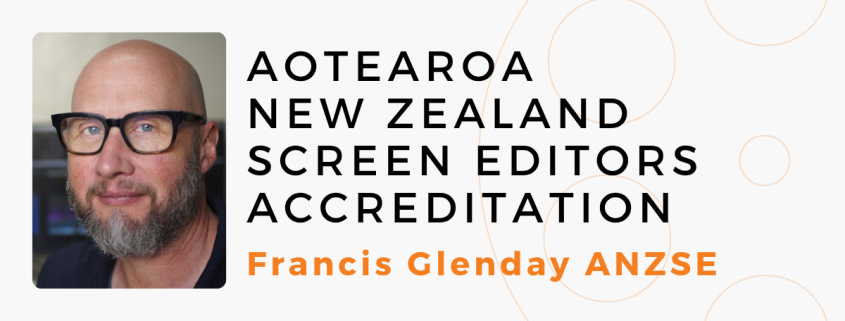
DEGANZ is proud to announce that Francis Glenday has been awarded Aotearoa New Zealand Screen Editors (ANZSE) Accreditation!

Established by DEGANZ in 2025, ANZSE Accreditation recognises master editors whose work consistently meets a world-class standard. The accreditation celebrates the mana, artistry and expertise editors bring to their craft, provides a benchmark for excellence, and helps identify highly experienced editors for projects both in Aotearoa and internationally.

Francis was approved for accreditation by the ANZSE Committee, joining inaugural recipients Annie Collins ANZSE, Peter Roberts ANZSE and Jonno Woodford-Robinson ANZSE.

In awarding Francis the accreditation, the committee recognised:

[His] broad range and depth of editorial skills gained over 25 years, encompassing aptitude with cross-cultural work, DEGANZ Board and committee service, training and mentoring as well as designing post systems at an international level.

Francis brings decades of editorial experience across feature films, documentaries, factual and drama series, and commercials for local and international audiences. Some of his most notable works include feature docu-drama Sgt. Haane (2026), HBOMax Original There is No ‘I’ in Threesome (2021), and feature documentary Poe E: The Story of Our Song (2016). He has also worked on major live broadcast productions, serving as lead editor and head of post-production for the international broadcasts of the 36th and 37th America’s Cup.

Alongside his editorial career, Francis has made a significant contribution to Aotearoa’s screen industry. A DEGANZ member for almost a decade, he has served five years on the Board and contributed to a range of sub-committees, talks, events and industry presentations.

Francis has also been committed to supporting the next generation of editors, training and mentoring numerous junior editors throughout his career. His expertise extends beyond the edit itself, with experience developing and implementing post-production systems designed to streamline workflows, improve processes and support efficient collaboration across productions.

Congratulations, Francis, on this well-deserved recognition!


Last updated on 22 October 2026

This October, Show Me Shorts is bringing over 100 screenings to 40 cinemas across Aotearoa, with 11 DEGANZ members selected across the 2026 programme.

Show Me Shorts is Aotearoa NZ’s leading international short film festival, connecting audiences with short films from around the world while championing local filmmakers. It is one of Aotearoa’s most prestigious programmes to screen in as an Oscar, BAFTA and GOYA-qualifying festival.

Check out the full list of DEGANZ’s members involved below:

Aotearoa Strand

Beautiful stories of our land and our people. The films in this collection showcase the work of talented Aotearoa New Zealand short film makers. Bold coming-of-age films sit alongside thoughtful drama, silly comedic fun, inventive fantasy, and warm-hearted documentary. We explore unlikely friendships, face our past, and step into the unfolding future.

Kurī

Editor: Sam Small

Producer: Julie Zhu

Kurī hasn’t been back to Te Urewera since she was bitten by a dog as a child. After her father’s passing, Kurī must face her grief and go home – whether she’s ready to or not.

Lucky Luke

Director: Jesse Griffin

Eighteen-year-old Luke’s morning sleep-in is disrupted by his solo mum, with the news that their domestic set-up is transitioning from mother and son to flatmates.

The Owl and the Rainbow

Director: Jo Luping

Writer: Lynda Chanwai-Earle

Based on a true story, a mother must find the courage to soar to the moon and battle the creature of death, or lose her daughter forever.

The Return

Editor: Alex Boyd

When Lupesina answers her ancestors’ call, she must find acceptance of herself, or risk being stuck in the in-between.

Six Minute Supplement

Writer/Director/Producer: Sinead Lau

A brother and sister overdose on entitlement when a sample drug swaps their bodies.


Day One Shorts Strand

Show Me Shorts is proud to present this collection of new short films, commissioned and supported by Day One Hāpai te Haeata. The shorts are made by talented young filmmakers who are interested in exploring stories about building resilience, ancestral memory, connection to others and finding their place in the world. They are boldly taking story risks, pushing the envelope, and looking to the future.

Silver Lining

Writer/Director/Producer: Harriett Maire

Editor: Josh Yong

Approaching 25 years with a chronic illness, Harriett Maire explores how it feels to live with type 1 diabetes.

Mutually Assured Destruction

Writer/Director: Connor Amor-Bendall

Editor: Sam Small

A casual drink between four exes quickly sours into queer chaos when a long-buried secret surfaces, putting whatever hope they have of friendship on the line.


The Sampler Strand

Taste a selection of highlight short films from Show Me Shorts Film Festival. These inspiring and thoughtful stories include long-distance love on a distant planet, precocious children up to mischief, a whole town waiting for bad luck to pass, and a man stuck in a time loop. Comedy, science fiction, romance, and coming-of-age classics abound.

Socks

Writer/Director: Todd Karehana

In small-town NZ, a young Māori boy feels an unexpected bond with a Mormon missionary.

Ciggie

Editor: Scott Milligan

In the bush behind their suburban houses, two children tell stories, tease, and confide in each other, all while sharing their first cigarette.


Run For Your Life Strand

Prepare to fear. The zombies are coming. A worm is giving you dark orders. And the coyotes are out there. Do not open the door or drink from that chalice. Strange creatures lurk, and our deepest fears can be brought to life in this decidedly frightful collection of short films.

Scared Old Men

Director/Editor: Stella Reid

Music video for the song ‘Scared Old Men’ by Dick Move. Screaming at the violent and decaying patriarchal system that shapes the world through fear, control and suppression.


Odd Balls & Absurd Calls Strand

In this collection of short films, we explore intriguing worlds that are just one step from reality. We look through lenses of strangeness and meet amusingly unusual characters in odd settings: a puppet having an existential crisis, two Kung Fu masters on a date, an artist searching for the perfect thrift-store find, and a poet trapped in a society that frowns on talking. It’s an inventive reverie you won’t want to wake from.

埋單 (Let’s Settle This!)

Writer/Director/Editor: Jack Woon

Elle and Winson are brought together by a dating app – or is it fate? After their date, they must settle the bill…and an ancient blood feud.


Whānau Friendly Strand

In this collection of short films for children and their families, cute animals and inquisitive insects spring to life in vibrant stories. Characters learn about kindness, curiosity, and heart as they defeat negativity and overcome bullying by working together—with a dose of magic and explosions for good measure! Find out why this is one of the most popular sections of Show Me Shorts.

Lemonade

Writer/Director/Editor: Logan Sutherland

In the cutthroat business world of lemonade stands, the sister/brother dream team of Suzy and Jack descend into bitter rivals as they chase success and sweet profits.


Last updated on 22 October 2026