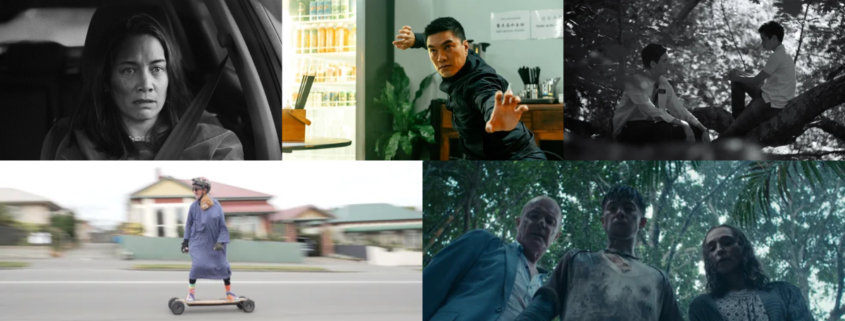
Congratulations to DEGANZ members Julie Zhu, Sam Small, Todd Karenhana, and Jack Woon for their recent wins at the 2026 Show Me Shorts awards ceremony.

Show Me Shorts is Aotearoa’s leading international short film festival, championing local filmmakers and connecting audiences with short films from around the world. DEGANZ is proud to have sponsored the Best Director and Best Editor categories, which were awarded to Tom Noakes and Anna Frances Pearson, respectively.

Produced by Julie and edited by Sam, Kurī won the Oscar-qualifying Best New Zealand Film Award. The coming-of-age film follows a young woman who returns home to Te Urewera following her father’s death, confronting grief and childhood trauma. Oscar-winning director Martin Strange-Hansen and Show Me Shorts judge commented on the film, saying:

Kurī is strong in every aspect of its filmmaking. From the magnetic acting to the beautifully shot imagery, and the well-paced editing, through to the clear voiced direction.

The kung-fu comedy-drama 埋單 Let’s Settle This!, written and directed by Jack, won the Script to Screen Best Screenplay award. When a dating app brings Elle and Winston together, they must settle the bill and an ancient blood feud.

Todd’s black-and-white film Socks was recognised for its cinematography, with DOP Tim Flower taking home the Kōawa Studios Best Cinematographer Award. Socks is the story about a twelve-year-old Māori boy who develops an emotional and romantic fascination with a visiting Mormon missionary.

Tom’s direction of The Worm, a horror-comedy following a teen who becomes convinced a telepathic earthworm in his backyard is manipulating his thoughts, earned him the DEGANZ Best Director award. Meanwhile, Best Editor was awarded to Anna for Bob & C-Nut: A Good Way to Start the Day – a vignette of an unconventional friendship with a 40-year age gap formed over a love for skateboarding and music. 

Voting is currently underway for the People’s Choice Award, which will be presented at the conclusion of the festival. Audience members can vote for their favourite film via the Show Me Shorts website here.

Congratulations to all the winners!


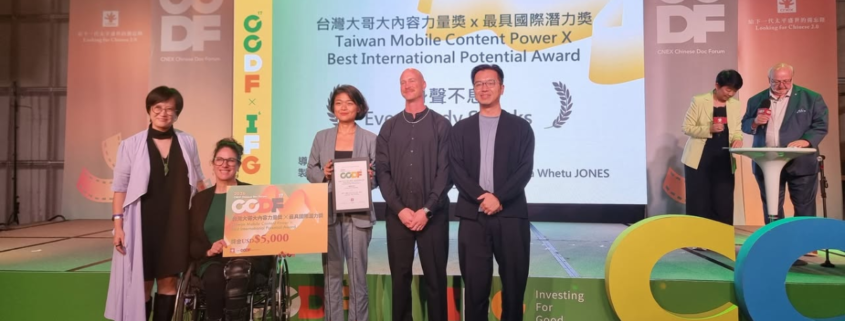
Documentary in development, Every Body Speaks won the Taiwan Mobile Content Power x Best International Potential Award at CCDF-17, one of the biggest documentary industry forums in the Chinese-Speaking World. DEGANZ member John Ross is attached as both the director and director of photography, with fellow member Paula Whetu Jones as producer.

Every Body Speaks follows a dancer through her recovery from a brain injury. Set in Taiwan, the film captures the essence of community and the limitless potential of performance and collective art.

While at CCDF, John and Paula worked with industry mentors to sharpen their pitches. They also had the opportunity to meet with a variety of documentary-focused festivals and programmers, including Sundance Film Festival, Sheffield DocFest, Tokyo Docs, and AIDC, as well as sales agents and distributors.

The film was first pitched at Doc Edge in Tamaki Makaurau, where it won the CNEX award, leading to an invitation to Taipei.

Congratulations, John and Paula, on this exciting project and can’t wait to see it develop further!


This DEGANZ Watch List features new factual series and the online release of the 2026 Day One Shorts, following their premiere at Show Me Shorts.

Season two of Licence to Drive, by DEGANZ member Robyn Paterson, arrives on 4 November. The series puts Kiwis with disabilities in the driver’s seat as they navigate the milestones, nerves and hijinks of learning to drive. Watch the trailer below for a first look at the new season.

Also new to the factual space is Te Ara Poutama, a web series directed by DEGANZ Vice President Rāhera Herewini-Mulligan. Edited by both Rāhera and her wife and fellow member, Janice Herewini-Mulligan, the series follows rising Māori talent in the music industry.

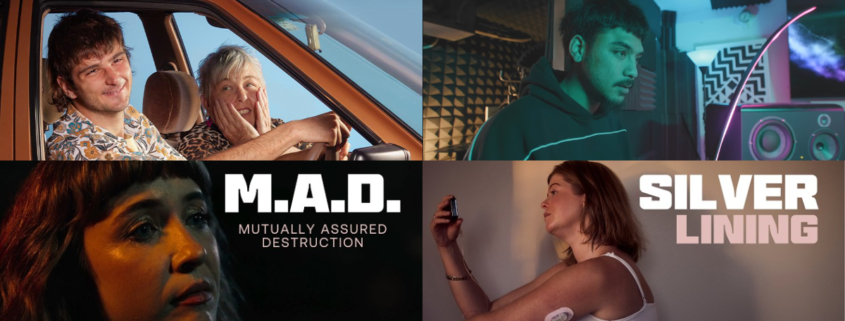
The 2026 Day One Shorts also spotlight emerging filmmakers, with both documentary and drama represented. In Silver Lining, Harriett Maire (DEGANZ) distils 25 years of living with a chronic illness into a 15-minute documentary, edited by fellow member Josh Yong. Meanwhile, DEGANZ member Connor Amor-Bendall explores the messy dynamics of friendship and exes in the short drama Mutually Assured Destruction, edited by Sam Small (DEGANZ).

Check out the trailer and explore the latest releases below!

Licence to Drive S2

Factual Series 

Executive Producer and Director: Robyn Paterson

Licence to Drive returns for a second season, featuring a new group of Kiwi drivers with disabilities taking on the challenge of getting behind the wheel, alongside some returning favourites who are taking the next step in their driving journeys. Across the season, drivers work with instructors, families and support networks to build their skills and confidence, while discovering what it takes to make driving work for them. Some chase the freedom that comes with a licence for the first time; others return to see how far they can go.

Coming soon to Sky from 4 November.


Mutually Assured Destruction

Short Film

Writer/Director: Connor Amor-Bendall

Editor: Sam Small

A casual drink between four exes quickly sours into queer chaos when a long-buried secret surfaces, putting whatever hope they have of friendship on the line.


Silver Lining

Short Documentary

Writer/Director/Producer: Harriett Maire

Editor: Josh Yong

Approaching 25 years with a chronic illness, Harriett Maire explores how it feels to live with type 1 diabetes.


Te Ara Poutama

Factual Web Series

Director: Rāhera Herewini-Mulligan

Editors: Rāhera Herewini-Mulligan & Janice Herewini-Mulligan

A new series by Waiata Anthems showcasing some of the amazing emerging Māori talent in the music industry. Supported by the best of the best–established tuakana artists who want to see them flourish–the series follows different artists’ stories and songs.


View from the Top banner

I attended the opening night of Show Me Shorts the other night. As always, there was a lot of joy in the air with the latest batch of New Zealand and international shorts going up on screen, and many of the filmmakers, cast, crew, friends and family there to share the occasion.

All of the shorts incorporated humour in their own distinctive ways, shapes and forms. And in an industry beset by problems, it was a welcome relief to sit back and have a good laugh.

Unfortunately, there is considerably less to laugh about when it comes to the state of our industry.

The single most pressing issue facing DEGANZ and the other screen guilds and associations is the New Zealand Film Commission’s decision to cut core funding following their review around sector cohesion.

There were no clear terms of reference. There was confusion from the outset about what the review was actually intended to examine. And an embargoed media release was issued shortly before the fateful meeting, effectively pre-empting what was meant to be a discussion about sector cohesion.

It felt as though we had been hung, drawn and quartered before the process had properly begun.

Two of the many questions left hanging are simple ones: who actually made this decision, and why?

The answers we have received so far have been nebulous.

More puzzling still is the suggestion that this decision was driven by government concerns, particularly when the country may well have a different government in six weeks’ time.

But there is a more fundamental question here.

What is the NZFC for?

Core funding for guilds and associations has been contentious for as long as I have been in this role. The recurring question is: why should the NZFC support the organisations that represent and strengthen New Zealand’s small screen industry?

That is a perfectly legitimate question.

In fact, it should be asked periodically. Who needs support? Who doesn’t? What work delivers the greatest benefit to the sector? How much funding is appropriate? Are there better ways of delivering particular functions?

None of those questions is unreasonable.

But there is a significant difference between conducting a proper strategic review of those questions and making a funding decision through a process that appeared to lack clarity, transparency and a coherent strategic rationale.

And, importantly, the NZFC’s statutory responsibilities cannot simply be separated from this discussion.

The New Zealand Film Commission Act 1978 requires NZFC to encourage and promote cohesion within the New Zealand film industry. It specifically identifies the exchange of information between industry participants, the efficient use of available resources, and cooperation with other organisations to promote employment and productivity as part of that function. The Act also gives the Commission broad powers to provide financial assistance and other forms of support to the film industry.

That matters.

Because the organisations receiving core funding are not simply a collection of unrelated special-interest groups competing for a slice of the same pie.

The occupational guilds represent the people who perform the roles that make our industry work. The equity organisations represent individuals and communities whose voices and participation have historically been under-represented. Māori organisations have particular responsibilities arising from the Crown’s relationship with Māori and the Treaty of Waitangi. And organisations that deliver professional development have helped build the capability of generations of New Zealand screen practitioners.

These organisations do different things. They represent different constituencies. And, inevitably, they sometimes disagree.

But disagreement is not the same thing as fragmentation.

In fact, the organisations receiving core funding communicate with each other constantly. We work together in smaller groups and, at times, collectively. We share information, support each other’s initiatives and collaborate on issues affecting the wider sector.

Yes, our views sometimes diverge. That is inevitable when you represent different parts of an industry.

But for the most part, we are interdependent—and we behave that way.

Which makes the suggestion that sector cohesion is somehow undermined by the existence of these organisations particularly difficult to understand.

If anything, the opposite is true.

These organisations are part of the connective tissue of the New Zealand screen sector. Some of what we do is highly visible: events, workshops, professional development, networking and other activities. But much of the work is less visible and arguably just as important—advocacy, lobbying, policy development, industrial representation, strategic conversations, information sharing and maintaining relationships across the industry and with government.

It is the sort of work that can be difficult to quantify precisely because its value is cumulative and sector-wide.

So why would we weaken the New Zealand screen industry by threatening the existence of organisations that contribute to its cohesion, capability and representation?

That does not mean guilds and associations should be entitled to core funding indefinitely.

They aren’t.

Core funding should be reviewed from time to time. It is entirely reasonable for the NZFC to ask whether the organisations it supports remain strategically important, whether they are delivering value, whether their roles overlap, and whether public funding is the most effective way to achieve the desired outcomes.

But such a review should have clear strategic intent.

It should be transparent about what is being assessed and why. It should consider the needs of the industry as a whole, rather than simply the cost to support individual organisations. It should recognise the different roles played by different parts of the sector. And it should be tested against the NZFC’s statutory responsibilities—not least its explicit responsibility to encourage and promote cohesion within the New Zealand film industry.

Most importantly, the process should be capable of answering a basic question:

Will this decision make the New Zealand screen industry stronger or weaker?

I am not convinced that question has been adequately asked, let alone answered.

What has happened instead appears to be a funding decision in search of a sufficiently coherent rationale.

And that is the real problem.

The debate about whether core funding should exist is legitimate. The debate about how much organisations should receive is legitimate. The debate about how the sector should organise itself is absolutely legitimate.

But if the result of the process is to weaken the very organisations that represent practitioners, build capability, facilitate collaboration and advocate for the health of the industry, then the NZFC needs to explain how that outcome advances its statutory responsibility to promote cohesion, cooperation and productivity across the New Zealand film industry.

Because right now, the answer isn’t clear.

And so, despite the laughter, the joy and the brilliant work on display at Show Me Shorts the other night, there isn’t much funny about any of this.

For those of us working to build and sustain New Zealand’s screen industry, it’s no laughing matter.


Tui Ruwhiu
Executive Director


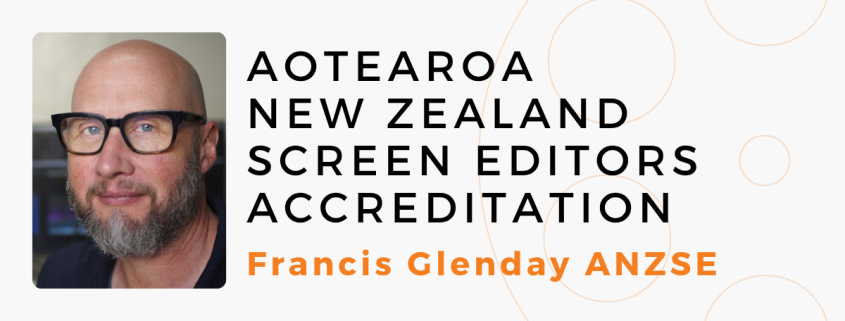
DEGANZ is proud to announce that Francis Glenday has been awarded Aotearoa New Zealand Screen Editors (ANZSE) Accreditation!

Established by DEGANZ in 2025, ANZSE Accreditation recognises master editors whose work consistently meets a world-class standard. The accreditation celebrates the mana, artistry and expertise editors bring to their craft, provides a benchmark for excellence, and helps identify highly experienced editors for projects both in Aotearoa and internationally.

Francis was approved for accreditation by the ANZSE Committee, joining inaugural recipients Annie Collins ANZSE, Peter Roberts ANZSE and Jonno Woodford-Robinson ANZSE.

In awarding Francis the accreditation, the committee recognised:

[His] broad range and depth of editorial skills gained over 25 years, encompassing aptitude with cross-cultural work, DEGANZ Board and committee service, training and mentoring as well as designing post systems at an international level.

Francis brings decades of editorial experience across feature films, documentaries, factual and drama series, and commercials for local and international audiences. Some of his most notable works include feature docu-drama Sgt. Haane (2026), HBOMax Original There is No ‘I’ in Threesome (2021), and feature documentary Poe E: The Story of Our Song (2016). He has also worked on major live broadcast productions, serving as lead editor and head of post-production for the international broadcasts of the 36th and 37th America’s Cup.

Alongside his editorial career, Francis has made a significant contribution to Aotearoa’s screen industry. A DEGANZ member for almost a decade, he has served five years on the Board and contributed to a range of sub-committees, talks, events and industry presentations.

Francis has also been committed to supporting the next generation of editors, training and mentoring numerous junior editors throughout his career. His expertise extends beyond the edit itself, with experience developing and implementing post-production systems designed to streamline workflows, improve processes and support efficient collaboration across productions.

Congratulations, Francis, on this well-deserved recognition!