The Accidental Editor

It was 2009 and I’m working at Unity Books in Auckland, my specialty – children’s picture books and classics of literature. It’s been 2 years since I quit my career as an art director in advertising with no intention to ever step back into that world. I loved selling books and I still work at Unity from time to time, but in 2009 I was hoping to find a new path.

A friend mentioned a job going at TVNZ. They were looking for creative producers with an advertising background. A ‘creative producer’ makes 30-60 second promo videos for movies and shows; you write a script, edit the footage, direct the voice over talent, select music, SFX etc.

My only film editing experience was that once, I made a joke video on iMovie to amuse a friend, but I brazenly applied all the same.

To this day I’m still not quite sure how I was hired, it was a total accident, didn’t ask for it, fell on my lap. Perhaps a mix of luck and fate. TVNZ sent me on a two-day crash course to learn Avid Media Composer. The next day I started working. It was incredibly hard, I felt like a senior citizen learning computer skills, and back then there were no YouTube tutorials. The first few months I’d work late nights, I’d work weekends and study other people’s work, frame by frame. Why does one cut on a particular frame? What makes an elegant edit?

One day, my Creative Director pulled me aside and told me that he thought I had the right sense of timing to be a good editor. This encouragement drove me to want to be the best at TVNZ and I continued working late nights and weekends. The work projects became more complex and I was trusted to cut important campaigns, brand montages. I won international awards. In 2015 I became a freelancer. I worked for Sky TV and edited commercials with the ultimate goal in mind – to edit movies!

Sometime in 2016, I bumped into an old friend – director Florian Habicht. He’d recently returned from living overseas and told me he’d noticed my work. “One day we’ll work together,” he said. That comment encouraged me enormously. I was determined to make that happen, I just didn’t know how to make the switch from TV to film.

Editor Anastasia Doniants photographed by director Lula Cucchiara / Photo: Supplied

A personal connection helped. A friend of mine, director Jessica Sanderson, asked me to edit her NZFC funded short film, Ways to See. Again, luck was on my side, Annie Collins – the greatest editor in New Zealand – agreed to mentor me through this project. My fate was set there and then. Annie taught me everything about long-form: the workflow, the protocols, how to log, the assembly process. Annie also suggested that I trust my instinct, and this is something that can’t be taught, it must be in you as a person. Ways to See and my second short film, Ani by Josephine Stewart-Te Whiu, travelled the world with much success. This gave me confidence to continue to edit.

Educational institutes are not the only paths to knowledge, nowadays. I’m sure going to film school would have been of great help and, personally, I wouldn’t encourage anyone to follow my path. What helped me is that I was a movie mad kid. Movies and books took up most of my imagination growing up. My advice to young people – your hours of watching films are not wasted. Be curious. Be generous with your time as you’re investing in your future, if it means working for free – do it.

Most importantly, you have to love the magic and spectacle of film or else you’re in the wrong industry.

“Astonish me,” Sergei Diaghilev used to say to his dancers. “Astonish me,” I say to every person involved in the process of movie making.


About Anastasia Doniants

Anastasia is an award-winning editor based in Auckland. In the last few years, she has edited feature film documentary Fiona Clark: Unafraid, co-edited documentary James & Isey; as well as short films, documentaries and music videos.

How I Got Started in the Industry is a guest blog series from the Directors and Editors Guild of Aotearoa New Zealand (DEGANZ). Our members reflect on how they made their way into assistant editing, editing, and directing—with no two stories the same. They offer advice for those starting out. Get in touch with admin@deganz.co.nz if you’re a member and would like to share your story.
The biggest change ever to happen to the New Zealand screen industry is fast approaching. No, it’s not the merger of TVNZ and Radio NZ. It’s the Screen Industry Workers Bill (SIWB).

Before the end of the year, the SIWB is almost certain to become legislation.

Representative bodies for all workers in the screen industry, and DEGANZ is one of them, will engage with the Screen Production and Development Association (SPADA) and perhaps others once the Bill becomes an Act, to negotiate collective agreements that will set minimum terms and conditions under which contract screen workers will carry out their work.

Writers, Actors, Directors, DOPs, Production Designers, Editors, Visual Effects Artists, Sound Engineers, Composers, Grips, Gaffers, Makeup Artists, Wardrobe Designers—the list goes on to cover every contractor involved in making Film, TV, Games and Advertising, with a few exceptions.

Everybody in those roles being negotiated for will get a say in deciding the terms and conditions for their roles, if they want, through a democratic voting process that will cover members of guilds and non-members alike.

These agreements will be for both domestic productions, and international productions shooting here.

The agreements will be baseline agreements, meaning terms and conditions cannot be any less than what is negotiated. However, those terms and conditions can be improved upon through Enterprise (individual productions) and Individual Contracts. Where there are no Enterprise or Individual Contracts, the collective agreements will apply.

Most people in the New Zealand screen industry have never experienced collective agreements in their roles. The change the SIWB will bring about is perhaps the biggest to happen now and into the future for screen.

Misinformation and disinformation about the Bill could well play a part from here on in. So it behoves everybody in the screen industry to get the facts about the SIWB, because it is going to affect every one of you directly.

From here on in, guilds, associations and the Ministry of Business, Innovation and Employment (MBIE) will be running education programmes to not only inform screen workers but also the general public about what is happening.

A simple explainer is available here.

The detail of the Bill will shortly be finalised and will go back to the House for its Second Reading. Then amendments will be made through Supplementary Order Papers with the changes recommended by Minister Michael Wood before finally being passed into law with Third Reading.

Once the Bill is passed, there will be some work to ensure that everyone working in the screen industry has a contract in writing that sets out some mandatory conditions to deal with sexual harassment, bullying and discrimination and a clause dealing with fair termination. After that it will take some time before DEGANZ sits down with SPADA to negotiate the collective contract setting out the minimums for pay and working conditions for our occupational groups, but we need to start getting ready now.

I encourage all DEGANZ members to make the utmost effort to understand the SIWB because it will be vitally important to your futures.

Tui Ruwhiu
Executive Director

I’m 18, with frosted tips, earnest to a fault, about to graduate from South Seas Film & TV School. I post out my CV to every production company I can find: nobody bites. (Though, I did send it with a bar of soap wrapped in 16mm film and the opening line, “You don’t know me from a bar of soap…” *double cringe*).

Then one of my tutors puts me in touch with a graduate student who is working on The Lord of the Rings, shout out to Dan Story! Dan takes my CV to the production manager, Brigitte Yorke. While unimpressed with the soap, Brigitte, an alumnus of South Seas, appreciates my grades and hires me as a runner for two weeks. I martyr myself to the job. Changing lightbulbs, making coffee, spilling coffee, wearing my studio-issued ID like an Olympic medal. Two weeks turns into two months, and before I know it, I’m off to Wellywood, leaving behind my hometown in the Tron.

I quickly learn the magical business of show business can be a high-stakes, lawless place, and I’m sucked into the pressure, the hierarchy, the people. It’s intense, intoxicating, compulsive… a wild west of bullshit, politics, nepotism, sexism, slave drivers. And I bloody love it. Because when you finally see your name roll up in the credits, it’s suddenly all worth it. Addicted, I jumped from one film to the next… King Kong, The Water Horse, The Lovely Bones, Avatar, The Hobbit… going from runner to driver to cast PA. Watching. Learning. It wasn’t until I became James Cameron’s driver, 8 years after leaving film school, that I decided I had to tell my own stories. I quit James and made my first short film… and then the next one, and the one after that.

One day, producer Katie Millington saw my short Darryn Exists and took a punt hiring me, believing I could learn how to direct commercials. I moved to Auckland, but had nothing to show for myself, and advertising people want you to prove you can tell a story in 30 seconds or less. So I self-funded a couple of ‘spec ads’ to build a showreel for myself. This got me my first job directing a TV commercial. I guess things snowballed from there, but not without the loving mentorship I’ve received from great people and places along the way.

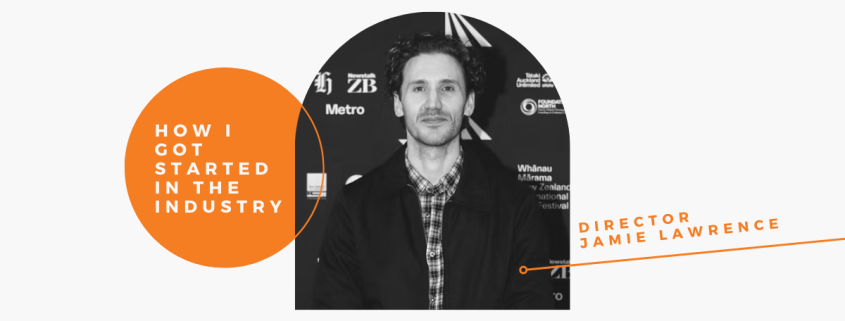
Director Jamie Lawrence on set / Photo: Supplied

Looking back, it really does feel like a collision of passion and opportunity that got me into (and keeps me in) the industry. Thank you, South Seas, thank you Dan, thank you Brigitte, thank you James, thank you Katie.

It can be a long road, so when it comes to weathering the storm, the things I tell myself:

Turn away from rejection, towards something you love. I’m quick to go on the offensive, taking shit personally. But actually, the truth is sometimes it’s them, not you. If I lose a job to another director, I reframe it in my mind like an actor who loses the role to somebody more “quirky looking” and “on brief”, while I must be too handsome for the part. Then I lock myself in my room and write my screenplay. This way, I not only ‘bounce back’ from the setback, but I also have something to ‘bounce to’.

Phone a friend. Nurture these relationships and connections because they are a wellspring to refuel from when you’re in the eye of the storm. Having a cup of tea/gin with a mate toughens/loosens me up every time.

You can say ‘no’. It’s human rights. Sometimes you can’t afford to turn down an opportunity. And sometimes you can’t afford not to. It’s okay to say ‘no’. For better or worse. It can be bad for business (ask my producer or my husband), but it also makes room for other important stuff. I’ve made a list of deal breakers that match my values – a way to measure a job and decide if it’s something I want to do. Yes… it’s idealistic, probably unsustainable, and sometimes I get a nosebleed on my high horse. But it’s not as bad as doing something I hate.

Good luck out there. Thanks for reading.


About Jamie Lawrence

Jamie Lawrence (he/him) is a queer Pākehā filmmaker based in Aotearoa New Zealand. His work has screened and won awards at NZIFF, MIFF, Festival des Antipodes, and Oscar-qualifying festivals including Show Me Shorts and Nashville. A scholarship graduate of NYFA and an alumnus of MIFF’s Accelerator Lab, Script to Screen’s FilmUp and Story Camp, Jamie’s recent short EARTHLINGS premiered at MIFF and was shortlisted for “NZ’s Best” at NZIFF. Having ranked among the country’s top commercial directors, he is now focused on his NZFC-supported feature slate: YA fantasy SKIN (Sweetshop Entertainment) and adventure biopic SOLO (Vendetta).

You can find out more about Jamie and his work on his website.

How I Got Started in the Industry is a guest blog series from the Directors and Editors Guild of Aotearoa New Zealand (DEGANZ). Our members reflect on how they made their way into assistant editing, editing, and directing—with no two stories the same. They offer advice for those starting out. Get in touch with admin@deganz.co.nz if you’re a member and would like to share your story.

I should preface by saying that I never planned to be working in the film and television industry. The honest truth is that when I finished school and decided to go to university, Film and Television papers seemed like a fun choice in amongst English, Sociology, Philosophy, and Art History. As it turned out, the Film and Television papers were the most engaging and fun, and that drove me into doing a Masters in Creative and Performing Arts, specialising in writing and directing for film. After graduation, my first paying gig in the industry was a small assistant editor role through one of my tutors. She connected me with a post-production supervisor who was helping facilitate a short film cutting from his house. It was exciting to be working on something film-related and I got paid a sweet $100.

Meanwhile, another contact through the same tutor, got in touch looking for an assistant editor on a children’s television drama. This would be my first dip into a longer form of drama, as well as a show that had quite a few VFX to contend with. It was at this point that I really began to get hooked into post-production. Even though pickings can sometimes be slim in our industry, I made the conscious decision to only do drama work which is where my passion lay. I was in a position in my life where I had very little financial out-goings and personal commitments so I let myself be open to opportunities, even if they weren’t my original plan. I was in no hurry to make the leap into editing and was hungry to get as much experience as I could.

Editor Jochen FitzHerbert editing Emmy Award-winning series ‘INSiDE’ from his home / Photo: Supplied

It was about five years of assisting work before my break into editing happened. I had assisted on a couple seasons of Power Rangers and one of the regular editors was starting back late due to a scheduling conflict. The returning producer offered me those blocks and I made the quick decision to make the official move to being an editor. Power Rangers was a great first show to cut as I was familiar with it from my assisting time there, but also it had the resources to have a big post team and manageable schedule.

The jump from assistant to editor is one of the trickiest things to manoeuvre. You forge a career as an assistant and work with a bunch of people around town, building a reputation only to have to turn on that and say that you are not that thing any more. Work can be slow in this transitional period but if you dig around enough there are little jobs you can flex your muscles on like low-budget web series or assemble editing.

As the Power Rangers season was finishing, Spartacus started shooting in Auckland. No, I did not get hired for Spartacus, but a lot of great local editors did which meant there was a gap in the industry. It was a perfect storm where the industry was booming and everyone was busy so there was room for people to step up. One of the directors I had just worked with on Power Rangers was going onto one of the said local dramas and he thankfully took me with him. From here, I felt I had my foot in the door.

My advice to anyone starting out now is don’t feel like you have to hurry. Make every job a learning experience and forge lasting connections with people you work with. You never know where or who your next job might come from.


About Jochen FitzHerbert

Jochen is an award-winning film and television editor with a long list of credits including Creamerie, Mystic, Power Rangers and The Gulf, for which he won an NZTV Award for Best Editing in a Drama in 2020. He also edited the international Emmy winning series INSiDE, which also won him a Webfest Award for Best Editing.

jochenfitzherbert.com

How I Got Started in the Industry is a guest blog series from the Directors and Editors Guild of Aotearoa New Zealand (DEGANZ). Our members reflect on how they made their way into assistant editing, editing, and directing—with no two stories the same. They offer advice for those starting out. Get in touch with admin@deganz.co.nz if you’re a member and would like to share your story.

At the end of 2021 the Government announced a review of government investment in the screen sector. The review will be led by the Ministry of Business, Innovation and Employment and the Ministry of Culture and Heritage. There is a document outlining the terms of reference for the review here.

This review is one part of a strategic review of the New Zealand screen industry, primarily focused on the New Zealand Film Commission’s direction and activity, including the New Zealand Screen Production Grant (NZSPG) for both domestic and international productions. However, NZ On Air’s direction and activity obviously falls into this because of the changing nature of the shifts occurring worldwide, as well as the fact that some NZ On Air funded productions utilise the NZSPG.

Our screen industry falls into two camps: domestic production, and international production (and post-production) that takes place here.

International production as we all know provides wonderful opportunities for New Zealand crew, and brings foreign investment to New Zealand. From DEGANZ’s perspective, what it does not do is bring great opportunity for New Zealand directors and editors. Only a very select few Kiwis get to direct, and sometimes edit on these international productions, being the international drama or sometimes documentary series shot here.

While we continue to push for more Kiwi directors and editors to work on these international shows, our main focus has got be on what we can do with domestic production to tell our stories here and internationally, and employ our directors and editors—and our actors, writers, producer and crews—so that they all can have thriving and sustainable careers.

Over the next three months, MBIE and MCH will be conducting a wide consultation with the NZ public and those who make up the NZ screen sector as part of the review. DEGANZ is now formulating its thoughts to bring to MBIE and MCH.

But there is an opportunity for each of our DEGANZ members to share their own thoughts in the consultation process.

When the call comes for submissions, we will inform you. Your voice counts and we want as many of you as possible to have your voices heard. This is a really opportunity for us all to have some influence on the future direction of NZ screen.


Tui Ruwhiu
Executive Director